
Author
-
Saioa Zorita
Researcher
TECNALIA
Spain
Co-author(s)
DOI
No DOI assignedUpload date
2025 Sep 17Last update
2025 Sep 17 16:09Priority
LowStatus
Not startedTags
Spatial Domain
EuropeanVersion
V5Training Module
No training module providedCurrent landscape of initiatives and standardisation norms and approaches
Abstract
Climate services provide climate information for use in decision-making to manage risks and improve
preparedness for climate change. Climateurope2 aims to develop future equitable and quality-assured
climate services to all sectors of society by developing standardisation procedures for climate services
and supporting an equitable European climate services community. The project will identify the
support and standardisation needs of climate services, including the existing landscape of standards
and standardisation activities dedicated to increase climate resilience of cities, infrastructure and
sectors as well as standards relevant for the components and processes to provide quality climate
services.
The work described in this deliverable aims at describing the standardisation importance and context
as well as it gathers the outputs of standard and guidelines search and describes the most relevant
standardisation initiatives to Climateurope2 project.
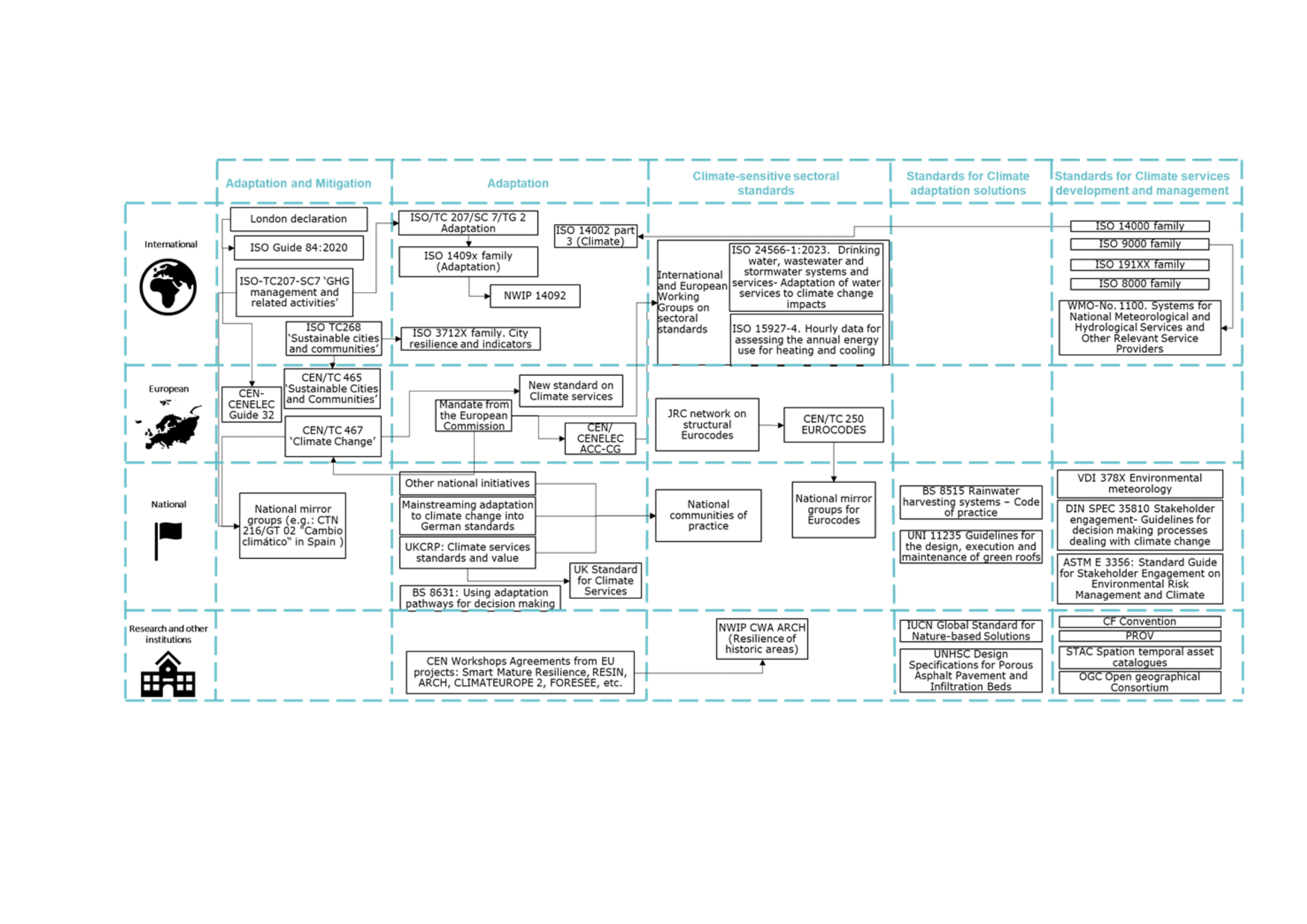
There are different standardisation activities at international, European and national level dealing with
climate change, community resilience and risk that provide an umbrella for data and user engagement
etc. in relation to climate change. It should be highlighted that the landscape of initiatives is expected
to grow due to different drivers. The London declaration approved in September 2021 by which ISO
committed to combat climate change through standards and achieve climate agenda by 2050. This has
translated into a commitment to review current and developing standards with a climate change
perspective. To achieve this goal, new working groups/subcommittees (e.g. ISO/TC 224) and
guidelines (ISO Guide 84) have been created.
Regarding the screening search of the existing standards, this has focused on four pillars targeting to
describe the context and needs in relation to:
− Climate change, security, risk and resilience of cities
− Quality Management
− Adaptation solutions
− Sectoral standards requiring environmental parameters
In order to identify those standards relevant to Climateurope2 a two-step screening methodology was
followed:
1. Title and descriptors relevancy: from more than 6000 entries 193 standards passed the first
screening criteria
2. Abstract and index relevancy: 91 standards passed the second screening criteria
These 91 identified standards were complemented with another 29 standards that resulted from an
occasional search to the ISO website and TECNALIA’s own knowledge on ‘climate change’ and
‘sustainable cities and communities’ set of standards, giving a total of 120 potential standards of
interests in various fields: from nature-based solutions and water management standards which performance and maintenance may depend on climate data to energy, building and transport sectoral
standards requiring environmental data.
Furthermore, this standard search was complemented with a revision of the guidelines, requirements
and good practices, mainly from the World Meteorological Organisation (WMO). It has to be
highlighted that these documents often refer to quality management standards as reference
documents for their development.
The performed analysis described in this deliverable will be revised and complemented as the project’s
activities advance and will incorporate WP 2 to 5 requirements, needs and vision in accordance with
Task 1.3 Synthesis and guidance information.
Click here to read the complete version
preparedness for climate change. Climateurope2 aims to develop future equitable and quality-assured
climate services to all sectors of society by developing standardisation procedures for climate services
and supporting an equitable European climate services community. The project will identify the
support and standardisation needs of climate services, including the existing landscape of standards
and standardisation activities dedicated to increase climate resilience of cities, infrastructure and
sectors as well as standards relevant for the components and processes to provide quality climate
services.
The work described in this deliverable aims at describing the standardisation importance and context
as well as it gathers the outputs of standard and guidelines search and describes the most relevant
standardisation initiatives to Climateurope2 project.
There are different standardisation activities at international, European and national level dealing with
climate change, community resilience and risk that provide an umbrella for data and user engagement
etc. in relation to climate change. It should be highlighted that the landscape of initiatives is expected
to grow due to different drivers. The London declaration approved in September 2021 by which ISO
committed to combat climate change through standards and achieve climate agenda by 2050. This has
translated into a commitment to review current and developing standards with a climate change
perspective. To achieve this goal, new working groups/subcommittees (e.g. ISO/TC 224) and
guidelines (ISO Guide 84) have been created.
Regarding the screening search of the existing standards, this has focused on four pillars targeting to
describe the context and needs in relation to:
− Climate change, security, risk and resilience of cities
− Quality Management
− Adaptation solutions
− Sectoral standards requiring environmental parameters
In order to identify those standards relevant to Climateurope2 a two-step screening methodology was
followed:
1. Title and descriptors relevancy: from more than 6000 entries 193 standards passed the first
screening criteria
2. Abstract and index relevancy: 91 standards passed the second screening criteria
These 91 identified standards were complemented with another 29 standards that resulted from an
occasional search to the ISO website and TECNALIA’s own knowledge on ‘climate change’ and
‘sustainable cities and communities’ set of standards, giving a total of 120 potential standards of
interests in various fields: from nature-based solutions and water management standards which performance and maintenance may depend on climate data to energy, building and transport sectoral
standards requiring environmental data.
Furthermore, this standard search was complemented with a revision of the guidelines, requirements
and good practices, mainly from the World Meteorological Organisation (WMO). It has to be
highlighted that these documents often refer to quality management standards as reference
documents for their development.
The performed analysis described in this deliverable will be revised and complemented as the project’s
activities advance and will incorporate WP 2 to 5 requirements, needs and vision in accordance with
Task 1.3 Synthesis and guidance information.
Discussion
Be the first to share your thoughts by placing a comment!
Login
or
sign up
to comment.